Free shipping, no minimum · 30-day guarantee · Made in Orange, California
The Energy Drink Cup Holder.com ← back to the energy drink page

The energy drink file

Why energy drink cans tip over — at the desk, in the cupholder, on the gym floor

A tall aluminum can is a worse match for the desk, the cupholder, and the gym floor than it looks, and the reasons are more specific than "it's tippy." This is the physics behind why it goes over, what the usual patches actually solve for, and what a base has to do about it.

The can is narrower than it looks

A standard aluminum can — the 2.60-inch body Monster, Rockstar, Bang, Reign, C4, and Ghost all share — isn't standing on that full width. Can bottoms draw up into a concave dome for stacking strength, so what actually touches the desk, console, or gym floor is a narrow foot ring recessed into that dome. Ball Corporation's own spec for that can family puts the foot ring at 1.92 inches, 0.68 inches narrower than the visible body.

That gap matters more once the can is full: a 16 oz tallboy stands roughly six inches tall, carrying most of its weight above a base already narrower than it looks. The physics needs no citation — the taller the load relative to its support, and the narrower that support, the less sideways force it takes to walk the center of gravity past the base's edge. A can on a foot ring under two inches wide is exactly that setup, on almost every surface it lands on.

Newer "slim can" formats don't fix this. The industry "sleek" can body Celsius and Alani Nu use runs about 2.25 inches, already narrower than a tallboy's 2.60, with a foot ring narrower still. Red Bull complicates the label further: its 12 oz and 16 oz cans share the wider 2.60-inch tallboy body, and only its short 8.4 oz can is truly narrow, at about 2.08 inches — "slim" on the label doesn't reliably predict what's touching the table.

Four surfaces, none of them built for it

The factory cupholder predates the tallboy: it was sized to the drink-cup standards of an earlier era, and nothing about its design accounts for six inches of can rising past its own grip zone. Nothing touches the can above the base, so every seam in the road works on that narrow foot ring alone — it isn't one bump that tips it, it's the accumulation of small vibrations with no resistance above the base line.

A gaming or study desk fails differently. The surface itself is fine — the problem is real estate. A monitor, keyboard, and mouse mat claim most of a desk's width, and the one open patch left usually sits inside the mouse's own sweep arc — exactly where an unlooked-at reach for a controller happens. The gym floor and dorm desk repeat the pattern smaller: rubber matting that's grippy but rarely level and shared with foot traffic, or a desk already carrying a laptop and notes with no square inch assigned to a drink.

Cold cans add one more variable underneath it all. Condensation beads off a chilled can right where that foot ring meets the surface, and a thin film of water is a lower-friction interface than dry aluminum on wood or laminate — the can's already-small contact patch gets slicker exactly when it's carrying the most weight.

What people try instead, and why the physics beats them

The koozie is the most common patch, and it treats the wrong variable. Neoprene fixes temperature and the condensation ring, not the base. A tallboy sleeved in one is still the same foot ring carrying the same tall load, now with extra height and bulk on top — if anything, that raises the center of gravity without widening the base, the number that actually decides whether it tips.

Clamp-on desk cup holders hit a different mismatch: geometry. A fixed ring has to be sized to one diameter, but this category spans more than half an inch — from a roughly 2.08-inch Red Bull mini can up through a 2.60-inch tallboy. Size it for the tallboy and a slim can rattles loose; size it for the slim can and the tallboy won't seat. That's a large part of why reviews of the same clamp holder read so differently depending on which can the reviewer drinks.

Console "stabilizer" inserts, sold mostly to truck drivers, are candid about the problem in their own marketing copy: the factory cupholder lets a drink rattle and spill, so here's a second product to fix the first. It's a real fix for the console, but bolted to one surface — useless for the same can at the desk twenty minutes later. Even a lidded G Fuel or Gamer Supps shaker cup only half-solves it: the flip-top lid limits what comes out if it tips, but not the tipping itself, and a full shaker is just as top-heavy as an open can.

Wondering about your specific cup? The fit database has sourced base measurements for 30+ containers — Stanley, Red Bull, Yeti, and the honest no's.

What a working base actually has to do

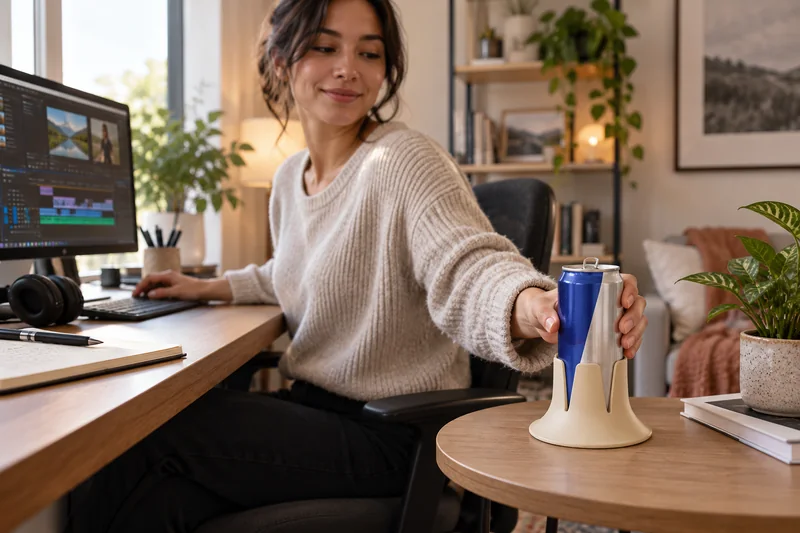
Two things follow from the physics above. The base under the can needs to be wider than the can's own foot ring, spreading weight across real surface area instead of balancing on a dome-recessed rim under two inches across. And whatever holds the can needs to reach up past that foot ring to grip higher on the body — the only way to resist sideways force instead of relying on friction at one narrow point.

It also has to work across the actual spread in this category — the roughly 2.25-inch sleek can, the 2.60-inch tallboy, room for the 40 oz tumblers the same shift often calls for — rather than one fixed clamp diameter tuned to a single can. That's the shape of the answer this category has needed: a base wide enough to spread the load, flexible fins that close on the can's lower body instead of just its foot ring, and enough give to keep working when the surface underneath it moves.

The shape isn't going away

The tall, narrow can format is spreading beyond energy drinks, not shrinking. Liquid Death built a whole beverage brand out of packaging plain water in a tallboy can — proof the shape has become desirable on its own, independent of what's inside it. That means the base-width problem above isn't a phase the category is likely to design its way out of. More drinks are adopting the exact geometry that makes a can tip-prone, on the same surfaces — desks, cupholders, gym floors, dorm rooms — that were never built for it.

Steadi Labs builds that base in Orange, California — injection molded, fins sized to close around the can's actual lower body instead of trusting its narrow foot ring alone. It's the physics every surface above has been asking for a fix to.

Choose your colors — free shipping

You'll finish at steadilabs.com — Steadi Labs is the manufacturer.